Thursday, August 5, 2010

More Parts and Even More Parts

More Parts (Picture Puffins)Even More Parts

In More Parts and Even More Parts, Tedd Arnold creates a humorous and sometimes frightening story from a child's perspective. Students delight in the scary images that enter the main character's mind as he worries about sayings such as "I'll bet that broke your heart," "give me a hand," "Hold your tongue," and "screams her lungs out". These are "must have" books for teaching idioms.

Idiom Books

In this activity, students collect idioms and their definitions in a side by side 3/4 book  Foldable®.

Directions:

  1. After reading the book, have students make a 3/4 book Foldable® . You can find directions in any of Dinah Zike's Foldable® books. 
  2. Assign or have students choose an idiom from the book and do the following: 
  • Open the 3/4 book, and on the outside of the folded tab, draw a literal illustration of the idiom.
  • On the tab to the left of the picture, write the idiom.
  • Under the tab with the illustration, write a sentence using the idiom that provides a clue to its meaning.


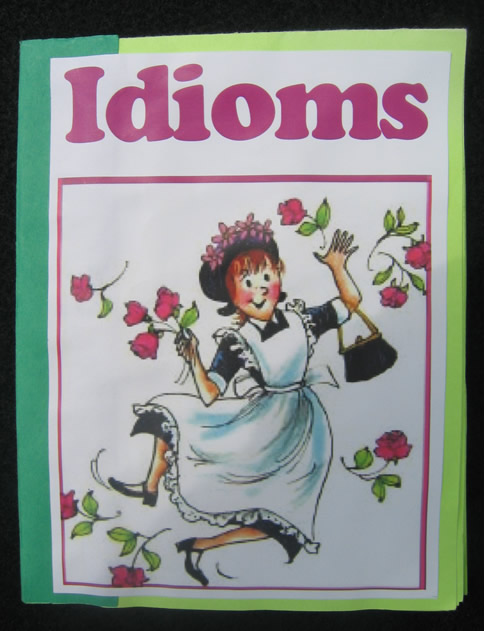
As students discover more idioms, they can create more 3/4 books which can be glued side by side. When complete, have the students bind the 3/4 books together and make a cover. We glued on a cover with Amelia Bedelia because we also read Amelia Bedelia books.


Wednesday, August 4, 2010

Helping Children Understand Positional Words and Opposites

Over, Under and Through

Tana Hoben's wonderful book Over, Under and Through, is the perfect way to introduce positional words and opposites. Leap-frogging over a fire hydrant, ducking under "London Bridge," crawling through a pipe tunnel -- Tana Hoban's brilliant photographs of children transform these activities into a fascinating exploration of spatial concepts. There are twelve concepts in all -- and some surprising discoveries for the young child.

Larger Than Normal Foldable®

In this activity, the class creates a big tabbed book modeled after Tana Hoben's book. On the outside of the tabs are spatial concept words. Lift up the tabs and surprise! There are photos of a beloved class stuffed animal sitting under a table or high on a shelf.

Directions
  1. To prepare, create a large eight door shutter fold Foldable® out of poster board. You can find directions for creating a shutter door foldable in any of Dinah Zike's Foldable® books. Turn the eight door shutter fold vertical or landscape and write the words above, high, over, and top on the outside of the top tabs and the opposites of each word on the bottom tab (below, low, under, bottom).
  2. After exploring the spatial concepts through the delightful book Over, Under and Through, have students help you take pictures of a stuffed animal sitting around the room in various places to illustrate each word. For example, ask students "Where can it sit so that it is above? Where would it be low?"
  3. Print out and glue the pictures under the corresponding tabs. 
  4. Enjoy reading the class book together and place it in a reading center for students to read over and over. You can also have students find and glue other pictures that illustrate the concepts underneath the tabs.

Zoom In, Zoom Out


Zoom (Viking Kestrel picture books)
Zoom

In the wordless picture book, Zoom, the author, Istvan Banyai, takes readers on a visual journey full of twists and turns, one step at a time, as they realize that nothing is what it seems. At journey’s end, they finally see the “big” picture. Great for making predictions, then revising predictions based on additional information. Students/children will be amazed when they “discover” what they have really been looking at all along!


Zoom In!

Create a Layered Look Book Foldable® to zoom in on a concept in Social Studies or Science. Zoom in from the solar system to student's houses, zoom from the outside to inside the human body or cell, zoom into the forest or the deep ocean, zoom into a cave, or zoom from the outside traits to the inside traits of a historical figure.


Zoom Out with the Zoom-Focus Project

Just like the book Zoom, things may not be what they seem as you get more information. Use the Zoom-Focus Project to zoom out of photos of people, places, and things. Challenge your students to predict what they think the photo is and to confirm or revise their predictions as more of the picture is revealed.

The directions, a template and other ideas for the Zoom-Focus Project can be found in Dinah Zike's Big Book of Projects on page 67.


Character Map Foldable®


Drita, My Homegirl

A sensitively written story of two worlds coming together, Drita, My Homegirl by Jenny Lombard touchingly explores the effects of war on a family and how friendship sometimes appears in the unlikeliest places.

This  Drita, My Homegirl character map Foldable helps students analyze the changes in the main characters, fourth graders Maxie and Drita, as well as their changing relationship.

Directions:
  1. Print out the Drita, My Homegirl character map Foldable and copy 2-sided. 
  2. Have students fold and cut it to create a six-door Shutter Fold Foldable®. You can find directions for how to make a Shutter Fold in any of Dinah Zike's Foldable® books.
  3. Ask students "Have you ever had a friendship that changed? A time when you are totally not friends with someone and then you become good friends? Or a time when you are really good friends and then you are not friends anymore? Write about a time that one of your friendships changed" Give students a few minutes to quick write. Then ask, "Why did it change? Did you change or did your friend change? Or, did something else change? Take a minute to write down your answer."
  4. Explain to students that in this story, Drita, My Homegirl, the relationship between the two main characters, Drita and Maxi changes over time. Tell students that as they read, they are going to pay very close attention to how each character changes or not, and how their friendship changes from the beginning of the story to the end. Explain that they will be using this Character Map Foldable® to hold their thinking as they read.
  5. Show students how to fill in the Foldable®. Under the tabs that say Beginning of the Story Drita and Beginning of the Story Maxie they need to write down each character's traits as they read the first third of the book. Tell students to write down evidence from the story that proves that Drita and Maxie have these traits. For example, in the story Maxie was rude because she made fun of Drita for being different. Drita is considerate because she helps her grandmother and responsible because she watches over her brother.
  6. Before reading further, ask students to lift up the middle top tab that says Relationship Between the Characters. This is where they will show how the two characters relate to one another. Above the top arrow, students write words or phrases about how Drita feels about Maxi (i.e. wants to be friends) and they write words or phrases under the bottom arrow that tells how Maxi feels about Drita (resents having to be her partner).
  7. After students finish the book, they need to repeat the steps with the bottom three tabs. 
  8. Students then answer the questions in the center of the Foldable®.